Multi-location SEO: Boost local visibility for each location

We’re all aware that the goal of any form of SEO is to communicate value to search engines like Google so that a business is seen as a relevant, trustworthy answer to searchers’ queries.
But with multi-location SEO, think about it as a form of customer service. Remember, the better the experience a local brand can provide for potential patrons both on and off the web, the greater its potential gains in the critical areas of reputation, rankings, and revenue.
The goal of multi-location SEO is to ensure that each branch of a business you’re marketing has an equal chance to be discovered and chosen by the community it serves. However, multi-location SEO comes with its own set of challenges, including scaling work like optimization and ongoing management across dozens, hundreds, or even thousands of locations.
Fortunately, once you’ve gotten confident with implementing multi-location SEO, you’ll reap the benefit of achieving growth in KPIs like online and offline traffic, conversions, sales, and customer retention across multiple geographic markets.
Why is multi-location SEO important?
The geographic market surrounding each branch of a multi-location business consists of an invisible radius. It’s within this border that Google will show the business as a result to searchers.
Remember, Google substantially personalizes both their local and organic results whenever they believe a searcher intends to find something locally. The market for each location’s branch will be unique, with a different radius and different competitors.
Some of the benefits of engaging in multi-location SEO include:
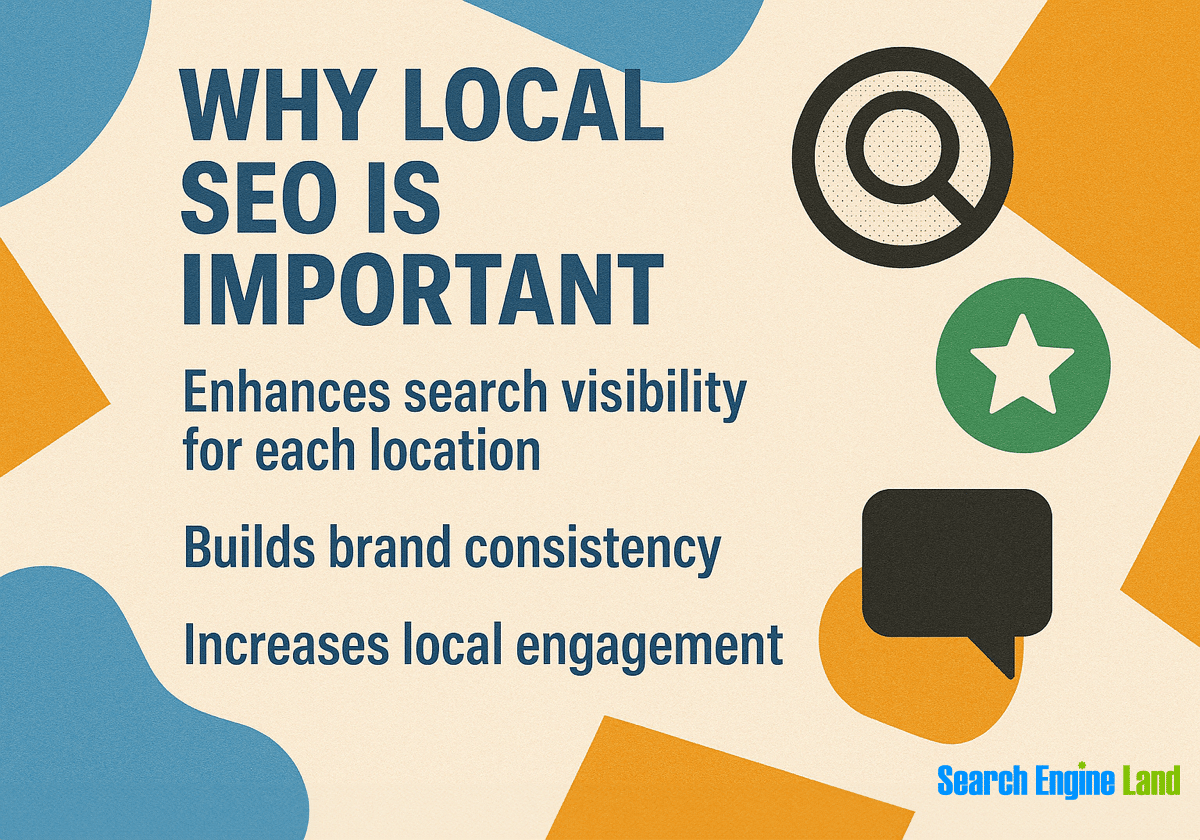
Enhancing local search visibility for each location
In the case of brick-and-mortar businesses (like restaurants, retail shops, and medical practices), the goal of multi-location SEO is typically to extend the radius of their visibility as much as possible so that they’re shown as a result to the maximum number of nearby searchers.
For service area businesses (like plumbers, HVAC companies, or home cleaning services), the goal is generally to earn visibility across their entire service area in local search results.
Hybrid enterprises (like a pizza brand with both on-site dining and home delivery) want to achieve both.
Regardless of business model, providing great consumer experiences begins with the brand you’re marketing being easily discoverable by its neighboring community.
In markets with a low level of competition (think of a brand that’s one of just two bakeries serving a whole small town), achieving an excellent level of visibility in a target market may require only a modest SEO and marketing effort. The more competitive the market (like, say, one of hundreds or thousands of personal injury lawyers in a metropolis), the greater the effort will need to be to achieve ideal visibility.
Building brand consistency across locations
At the brand level, a profitable reputation can be built on ensuring that each location is providing reliable, trustworthy, consistent customer experiences. A benefit of multi-location SEO is that it can help you develop a unified brand presence that will be encountered by potential patrons at the start of their journeys with the business you’re marketing.
Try to ensure that each branch of your company is being represented online with the following information:
- A consistent name
- Accurate contact information
- Correct hours of operation
- Responsiveness to reviews and questions
- Other useful content such as product and service availability
All of this content can build the foundation of trust-based brand-consumer relationships. Over time, a community can learn to count on both the online and offline customer service provided by the business you’re promoting, because they repeatedly have positive experiences with its online assets and real-world staff.
Meanwhile, search engines like Google can come to consider each branch of the business as a relevant answer because they’re encountering consistent and trustworthy information about it online, reviewers and social communities are speaking well of it, and third party publishers are citing and linking to it as an authority on its topic.
When properly marketed, each branch of a multi-location business can contribute to building a reputation for providing consistently excellent consumer experiences.
The SEO toolkit you know, plus the AI visibility data you need.

Increasing local engagement and foot traffic
It can be risky to oversimplify complex consumer journeys. Some models try to portray customers as moving neatly through stages like awareness > consideration > conversion > retention.
While it can be useful to think of these stages, the truth is that local consumers can take very circuitous paths, circling back and forth between multiple stages before making a transaction.
Ideally, each branch of the multi-location business you’re marketing needs to be there with the right help at whatever phase a potential customer may be in. A local customer journey might look like this list of moments at which your brand needs to be present:
Customer behavior: The customer is new in town and searches for “deep dish pizza late night near me.”
Business action: Does your branch nearest them come up as a Google local pack, Maps, organic, or AI Overview result?
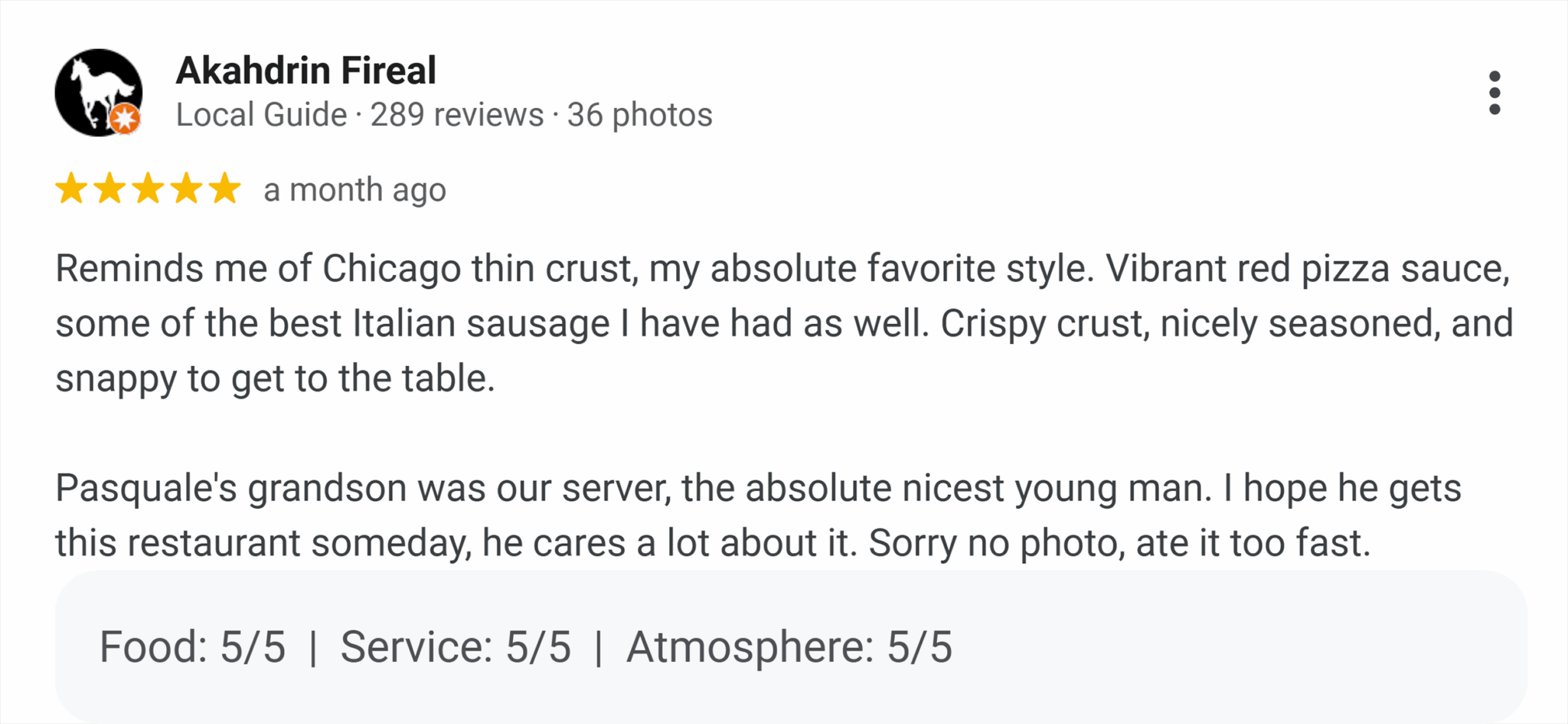
Customer behavior: Alternatively, the customer is a longtime local and already knows the names of nearby businesses. They do a branded search for your business, like, “does Pasquale’s Pizza near me do delivery?”
Business action: Is the Google Business Profile of the branch nearest this customer coming up for this branded search, and has full use been made of hours of operation, attributes, services, menus, descriptions, photos, Q&A, and other features to emphasize when and where this location delivers? Does the website feature the same information about this branch? Does the social media presence for this branch also feature consistent information?
Customer behavior: The customer moves from the Google Business Profile website link to a landing page on the corporate website.
Business action: Is the website link pointing correctly to the branch nearest the customer, and does it have the right actionable elements such as a full menu of local pizza options and e-commerce functionality for ordering home delivery? Do all of these elements offer a frictionless experience?
Customer behavior: Alternatively, the customer decides they would rather pick up their pizza themselves or dine on the premises.
Business action: Does the Google Business Profile and website location landing page for the branch nearest them offer accurate information about the availability of these experiences? If reservations are required, does the landing page enable the customer to make a booking? Are hours for onsite dining listed accurately for the branch? Is all contact information updated and correct? Are special local offers highlighted to encourage the customer to complete their transaction with the business?
Customer behavior: Post-transaction, the customer is dissatisfied with some aspect of their experience.
Business action: Is accurate contact information available on the branch’s listings, landing page, and social profiles to encourage one-on-one resolution? Has staff received abundant training in complaint resolution and escalation to defend brand reputation and customer retention?
Customer behavior: Alternatively, the customer may either not find it easy enough to complain in person, or may prefer to publish their complaint as a review on the branch’s Google Business Profile or other local business listings.
Business action: Has a professional reputation management program been put in place so that the unhappy customer receives a swift response from the branch owner or representative, offering to make things right? Has the branch been trained by the brand to engage in winning back dissatisfied customers to defend both local and brand reputation, optimize retention, and maximize loyalty and referrals?
When it comes to high-dollar purchasing decisions, a single searcher can cycle through multiple phases like those described above before becoming a customer who’s so satisfied with their experience that they’re willing to come back again for future transactions and to recommend the local branch to their circle.
By strategizing to be there with the right information and assistance, regardless of where a searcher is in their journey, each branch can:
- Increase user engagement with its digital assets
- Increase foot traffic and sales
- Increase average star ratings and positive reviews
- Be part of the overall positive reputation of the brand at large
Next, we’ll look at how to be there for potential customers with a strong multi-location SEO strategy.
Top multi-location SEO strategies
The key ingredients to multi-location SEO success
Multi-location SEO is comprised of a variety of practices, tactics, and habits. But before brands can make the most of their opportunities, they must prep for success with 3 key ingredients: brand standards, access permissions, and monitoring and reporting.

1. Brand standards
At the corporate level, the brand should maintain core documentation on the accurate information relating to each location of the business. It’s vital to keep this up-to-date in the event of moves, mergers/acquisitions, rebrands, and other changes.
The brand should also codify documentation surrounding brand voice, employee/franchisee training, and customer service standards.
2. Access permissions
A plan must be put in place to facilitate appropriate access permissions for each branch manager or franchisee. This could include access to landing pages, local business listings, and social media profiles. The degree to which leadership empowers local managers or franchisees to contribute to the management and marketing of each branch will be unique.
Whatever the decision on this, the brand may need to invest in software that delivers appropriate access to some assets while limiting access to others. Be sure all players have been provided with all relevant brand standards documentation, mentioned above.
3. Monitoring and reporting
Corporate must have tools in place for monitoring the performance of each branch over time. This could include access to reporting on rankings, reputation, responsiveness, competition, traffic, user behavior signals, link opportunities, earned links, structured citation health, and more.
Careful monitoring ensures that the brand can quickly identify performance downtrends at specific branches so that intervention and remediation can occur to defend overall company reputation and profits.
A little-understood secret is that, regardless of brand size, success across nearly all local SEO metrics is directly tied to online and offline customer service quality and user experience. Each branch manager or franchisee should be given all they need to deliver the kinds of customer experiences for which the brand wants to become known. Without great customer service, a brand will always be struggling to enjoy the full spectrum of rewards offered by multi-location SEO.
Using local keywords for different locations
A first step to marketing any branch of a multi-location business is to discover how the public is searching for what it offers. A great deal of your marketing strategy will be based on:
- Using keyword research tools to surface popular local search phrases
- Polling and surveying local communities to discover regional search language differences (for example, customers in one part of the country may be searching for “submarine sandwiches,” while those in another region want “grinders”)
- Using Google auto-complete and “People Also Ask” SERP features to discover additional ways in which customers may be searching for your products and services
- Practicing local social listening to understand how people in different communities talk online about businesses like yours
- Auditing nearby competitors to surface the search terms they’re using most frequently in their own marketing
The keyword phrases you discover for each branch will be used across multiple aspects of the business, including its landing pages, local business listings, review requests, product listings, listing menus and service sections, photography and videos, listing attributes, schema markup, Q&A, social media profiles, and so much more. They can also inform the primary and secondary categories you choose for your Google Business Profiles.
Create location-specific landing pages
One of the most valuable multi-location SEO practices involves the creation of website landing pages. These location-specific pages come in different varieties, including, but not limited to:
- Location landing pages for each branch of a multi-location business
- City landing pages for each service city within the radius of a service-area business
- Some brands may also need to create additional landing pages if their branches feature multiple practitioners (like a law firm with many partners) or multiple public-facing departments (like a car dealership chain with sales, parts, and service departments at each branch)
Typically, these landing pages are accessed on the website via a menu or store locator widget, and it’s a general local SEO best practice to link each Google Business Profile to its relevant landing page on the company website.
When dealing with dozens, hundreds, or thousands of locations, the main challenge is one of scale. If limited resources tempt large brands to publish large volumes of landing pages with thin, near-duplicate content, the pages often fail to provide ideal customer experiences. The brand may also be viewed by Google as having a habit of publishing low-quality content.
The truth is that major brands can sometimes get away with the publication of very low-quality landing pages. Google will still rank them highly, perhaps due to the brand recognition and authority they’ve accrued.
However, this doesn’t mean that they’ve maximized all opportunities for growth. Even the largest brands can experience upward movement in reputation, rankings, revenue, retention, and other vital metrics when they invest in developing best-in-class landing pages.
Sometimes, this work will require bringing in outside marketing partners. Other times, branch managers and franchisees can be empowered to undertake the marketing of their own assets (under corporate supervision).
Whichever arrangement best suits the multi-location brand you’re marketing, the top FAQ that will arise is how to differentiate each landing page so that it provides a uniquely valuable experience for local customers. The good news is, the opportunities are almost endless once creativity is unleashed.
Consider how all of the following elements could be incorporated in the process of customizing your landing pages to serve each local community and target audience:
- Complete contact information accurately reflecting current business information including name, address, hours of operation including seasonal and holiday hours, phone/text lines, email, fax and all other points of contact
- A unique USP for the location, based on its setting and offerings
- Photos depicting all aspects of the business, including premises, staff, projects, amenities, special offers, individual popular inventory, shelfies, company vehicles, and other localized content
- Videos depicting all of the above aspects of the business plus customer testimonials, staff interviews, vlog episodes, how-to tutorials, etc.
- Audio media including jingles, podcast episodes, etc.
- Real-time, location-specific inventory with e-commerce functionality
- Complete, location-specific product and service menus
- Location-specific, text-based online reviews and testimonials
- Location-specific special offers, contests, coupons, etc.
- Location-specific community involvement highlights, such as event and team sponsorship, philanthropy, scholarships, etc.
- PR highlights, such as local awards, news pieces, guest appearances on blogs, podcasts, and video channels, etc.
- Location-specific social media links
- Certifications
- Licenses
- Proofs of industry involvement
- Location-specific policies such as customer service guarantees, accessibility compliance, shipping and return policies, etc.
- Booking buttons and calendars
- Event calendars
- Unique local calls to action
This is just a starter list—there’s plenty of unique content you can add to your landing pages that’s useful to your local audience. The only barrier to developing the best local landing pages serving your area is finding the time and resources to devote to the work.
Optimize Google Business Profile listings for each location
Once you’ve developed landing pages for each branch of the business, you’re ready to create Google Business Profiles. There’s a document you’ll need to have at your fingertips for this work: The Guidelines for representing your business on Google.
This resource carefully explains how Google wants business owners and marketers to use their local product, and multi-location should pay particular attention to the following sections:
- Name
- Address
- Categories
- Chains and brands
Definitely read the entire document, but be absolutely sure that you’re complying with Google’s expectations on how you name your multi-location business, handle its addresses, choose its categories, and handle scenarios like co-branded locations.
Once you’re confident that you understand the guidelines, each branch of the brand has excellent opportunities for making unique and maximum use of its own listing. Here are fields to explore and optimize:
- Images/videos: Make a multimedia presentation of each branch by photographing and filming all the aspects of it that you know customers are looking for
- Q&A: Upload and answer the FAQs the branch receives
- Social media links: If each branch has its own social profiles, be sure to highlight them
- Google Updates/Posts: These are like microblog posts right on your listing that can focus on offers that foster conversions when encountered by searchers on the verge of transactions, such as highlighting a time-limited deal or upcoming sale
- Attributes: If relevant, use identifiers like “women-owned” or “wheelchair-accessible entrances” that signal that you can meet specific customer intents
- Service options: Include any relevant service options that pertain to your business, like “offers online estimates” or “American Sign Language assistance”
- Product and service menus: These are native Google Business Profile features that highlight your inventory and available services
- Google Merchant Center integration: This separate Google integration showcases store-level inventory
- Bookings functionality: If you’re a brand that takes appointments, include booking information
Google is constantly experimenting with new GBP fields, so an experimental mindset is best when managing your presence in this powerful system. Fields come and go over time, and while not all of them will be the right match for every business, be willing to test drive almost anything Google pilots. If it enhances the online experience that each branch of your business is providing to customers, it’s a winner.
Multi-location businesses will need to familiarize themselves with the ins and outs of Google’s bulk verification process. Manual verification of a large number of listings is typically too time-consuming to be scalable.
Manage local reviews and ratings
The most interactive element of Google Business Profiles is the customer reviews section of listings. An ideal multi-location SEO reputation management strategy masters all of the following for each branch of the brand:
- An ongoing review acquisition program is in place that both asks for reviews at the time of service and collects the email addresses, phone numbers, or text lines of customers and follows up with review requests
- Every review receives a speedy response from the listing manager
- Happy customers receive thanks for using their free time to praise the business
- Unhappy customers receive an offer to make things right, in hopes that they’ll give the business a second chance, update their negative review, and recommend the business to their circle once they’ve been satisfied
- An ongoing review sentiment analysis program is in place that captures positive upward trends at specific locations so that they can be studied and, hopefully, replicated across multiple branches. Perhaps more importantly, negative performance trends are quickly captured so that structural fixes can be implemented to defend both branch and brand reputation.
- Positive reviews are being remarketed in Google Business Profile elements like in photos, videos, and updates, on branch landing pages, in on-and-offline advertising, and via social media channels
In addition to reviews on third-party platforms like Google Business Profiles, brands can also put in place branch-level, first-party review acquisition and publication. In this scenario, each branch collects reviews directly from its local customers and publishes them on its landings pages.
This effort helps diversity landing page content because each location will have its own, highly-relevant reviews. First-party reviews have the added bonus of being owned by the business, instead of a review platform that might delete them or fail to publish them.
Structured citation development and management
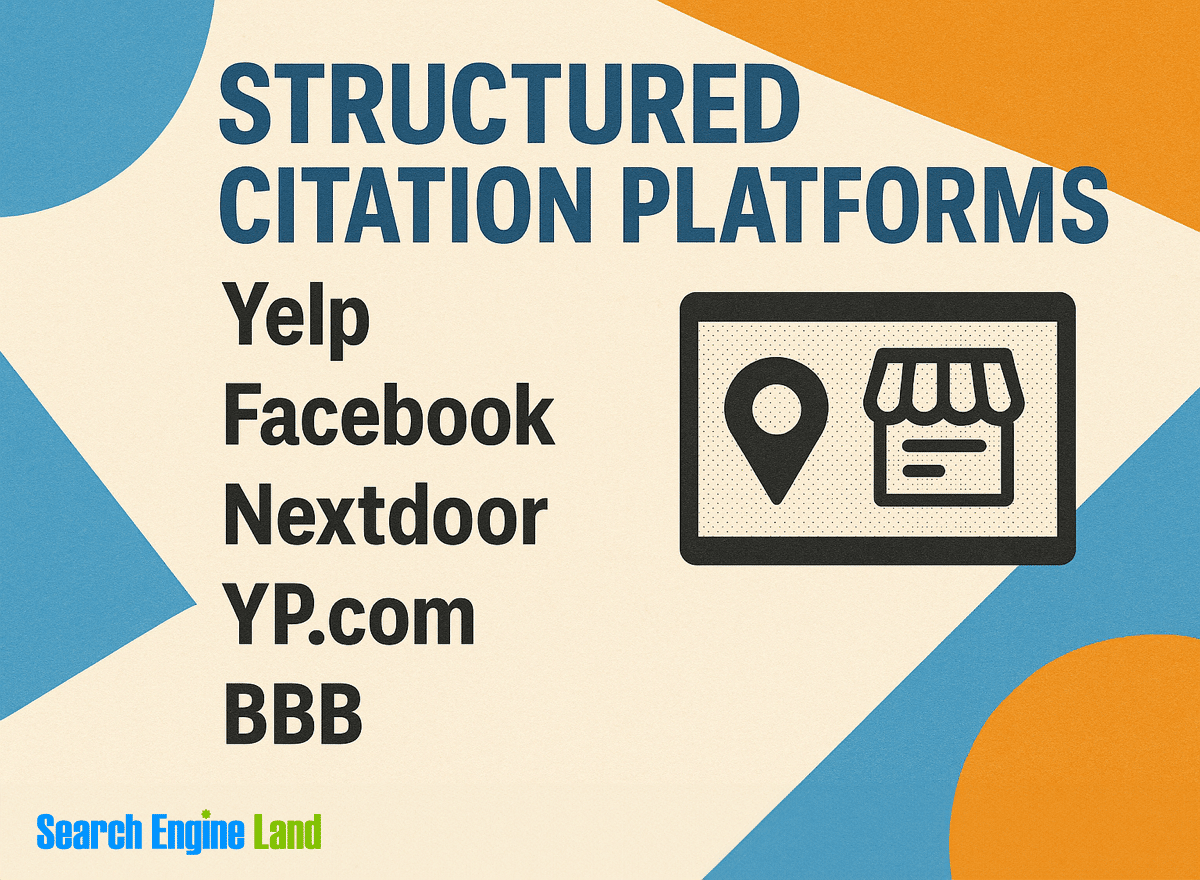
In addition to the creation and management of a Google Business Profile for each location of the brand, every branch should expand its digital footprint with the creation of listings on platforms like:
- Yelp
- Nextdoor
- YP.com
- BBB
There are also industry-specific local business indexes and local directories that should be explored (like TripAdvisor for hospitality brands, Findlaw for lawyers, and ZocDoc for medical professionals). Some communities will feature their own local business indexes, like Chamber of Commerce pages or community hubs.
These listings (called structured citations because they reside on formal local business listings platforms) must be created and then managed over time for accuracy so that searchers encounter trustworthy information about each branch across the web. They not only help potential customers find your business on third-party platforms (like Yelp, TripAdvisor, or Facebook) but can also add to “real estate” your brand takes up in Google’s own search engine results.
Unstructured citation development and management
Unstructured citations are mentions of the brand on any platform other than a formal local business index. Stakeholders at each branch of the business should be empowered to represent their location of the brand to its local community so that they can grow its unstructured citation footprint over time.
For example, a branch manager or franchisee can appear as a guest on a third-party podcast or video channel, speak to local reporters and bloggers, present at nearby or industry conferences, or host and sponsor local events. Whenever community engagement results in the business being cited, it develops the visibility and authority of both branch and brand.
One excellent aspect of unstructured citations is that you can frequently request how you’d like the business you’re marketing to be cited. This can help your brand become associated with desired keyword phrases of your choice.
For example, a branch of your business in Boise can ask that their city name be included in the citation, while your branch in Buffalo can do the same, but for their own specific location.
Unstructured citations must be managed in the event of business changes like moves, mergers/acquisitions, and rebrands. In such cases, the brand should audit the citations the location has received and contact the third-party publisher to request that information be updated if possible.
Monitor performance with SEO tools

For each branch of the brand you’re marketing, there are key performance indicators (KPIs) you should regularly track over time to measure the outcomes of your local SEO efforts and the ever-shifting nature of the competitive market. These include:
- Local and organic rankings: Map Rank Tracker and Position Tracking tools will help you monitor your Google Maps and organic rankings, while a tool like Whitespark’s Local Rank Tracker monitors Google local pack rankings
- Listing health and reputation: If you’re using a popular tool like Listings Management, it will report on the accuracy and consistency of your listings across multiple directories, the growth of your reputation, and the state of your competitors’ reputations
- GBP user behavior: Google freely reports back to you on the metrics including clicks-to-call, clicks-to-website, and clicks-for-directions on your Google Business Profiles
- Link metrics: A robust link building suite can help you audit top competitors’ backlinks and find new link opportunities for each branch of the business
- Traffic and conversions: Google Analytics 4 can help you track organic traffic to your website landing pages, engagement rate, session duration, and conversion rate
- Clicks, impressions, and CTR: Google Search Console measures clicks to your website from Google’s search engine results, total impressions, average clickthrough rate, and average organic positions
- Audience behavior: Tools like SparkToro can help you track information about online audiences including sites they visit, keywords they look up, and demographic data such as gender, age, hobbies, etc.
- Foot traffic: Products like Placer.ai can help you track and segment store foot traffic by zip code across multiple locations
All of the above metrics can help you measure the success of your local SEO efforts, with the most important measurement of success typically being sales or conversions.
Common pitfalls and how to avoid them in multi-location SEO
Each of the following threats to multi-location brand success should be identified, remedied, or altogether avoided:
Customer service failures
The biggest threat to the profitability and longevity of a multi-location brand is customer dissatisfaction. Unhappy customers will negatively review the business and erode its average star rating so that others don’t feel comfortable trusting it for future transactions.
Poor customer service creates a high rate of churn, necessitating costly investments in replacing lost customers with new ones. Further dissatisfied local customers share their negative experiences via word of mouth offline, preventing the brand from becoming a trusted community resource.
Whether a multi-location enterprise is a chain or a franchise, corporate’s most important task may be to ensure that rigorous staff hiring and training practices are being upheld across all locations.
Multi-seat access failures
If the SEO and digital asset management software being used by your brand doesn’t support sophisticated access permissions for all relevant stakeholders across the enterprise, marketing opportunities will be neglected. Unless your brand has sufficient internal resources to equally market all branches in-house, investments should be made to empower branch managers and franchisees to fully contribute to the marketing of each location.
When access is siloed or closed off to stakeholders, better-organized competitors can quickly get ahead of your poorly-resourced locations. Any properly managed location should be accurate, accessible, visible, and highly responsive to its community. Without this, customer dissatisfaction is almost sure to result and have a negative impact on rankings, reputation, and revenue.
Google Business Profile violations
Overlooking, misunderstanding, or intentionally violating Google guidelines can result in listing suspension, disablement, and verification woes. As mentioned above, adhering to the Guidelines for representing your business on Google is the best way to protect your visibility within their powerful system.
Miscategorization
Google requires that all locations of a business share the same primary category. Beyond that, the business is welcome to experiment with different secondary categories that best represent the offerings of each location. However, primary category discrepancies across multiple locations can inadvertently hurt all locations and prevent them from achieving optimum visibility in Google’s local packs, finders, and Maps.
Review violations
Google’s prohibited and restricted content guidelines outline everything you should avoid when it comes to review acquisition and management with their system. Be sure to never:
- Offer payments or incentives of any kind in exchange for reviews
- Positively review your own business or have your staff do so
- Negatively review your competitors
- Post reviews on behalf of customers
- Engage in review gating (the practice of routing only happy customers towards your review profiles while suppressing the sentiment of unhappy customers)
- Work with any marketing firm that offers to violate Google’s review guidelines
Review neglect
Unless each branch of the business is actively responding to its reviews, neglected negative reviews can quickly erode average star ratings while tarnishing the overall good name of the brand.
Neglected reviewers will increase customer churn rates, creating a scenario in which the business has to over-invest in new customer acquisition instead of assigning appropriate budget to complaint resolution that keeps existing customers happy and loyal, while also inspiring them to refer others to the business.
Structured citation neglect
Structured citations can be defined as formal profiles on any online local business listing index (think Yelp, TripAdvisor, Angi, YP.com, etc.). When listings are created on these platforms and then left in an unmanaged state over time, their accuracy erodes if core contact information changes, branches experience temporary or permanent closures, or the business moves.
Inaccurate citations represent a significant threat to branch and brand reputation because they create negative consumer experiences.
For example, a listing which contains inaccurate seasonal business hours for a particular branch will result in potential customers arriving at that location outside open hours. This inconveniences the potential patron and can lead to them negatively reviewing the branch and speaking poorly of it to their circle.
Track, optimize, and win in Google and AI search from one platform.
At bare minimum, multi-location enterprises should ensure that basic contact information, hours of operation, links, and premise photos are kept continuously updated across all listings for all locations of the brand.
Sitewide quality erosion
In August of 2022, Google rolled out the Helpful Content Update (HCU) which included a sitewide signal meant to reward website publishers with an overall pattern of publishing high-quality, helpful content. Multi-location brands need to pay particular attention to this in the context of location landing pages.
If the brand shortcuts the development of this core site content, it may fail to pass muster with the HCU, because it’s publishing a large volume of thin, unhelpful pages.
Additionally, corporate should ensure that all stakeholders with access to landing pages are avoiding any violations of Google’s spam policies. For example, branch managers and franchisees should be trained not to purchase links or engage in too many link exchanges.
The keys to multi-location SEO success
Multi-location SEO can best be understood as a rising tide that lifts all boats; the performance of each branch contributes to the overall success of the brand.
Smart enterprises will make strategic investments in:
- Stakeholder training and access
- Enterprise-ready software and tools
- Community engagement and responsiveness
- Branch performance across time
- Intervention and remediation whenever and wherever necessary
The keys to multi-location SEO success are organization, stakeholder empowerment, vigilance, and problem-solving. The proofs of success are happy customers, a positive reputation, and sales. Online and offline consumer experiences rule the day, and customer-centric brands will be winners.
Next up in your pursuit of local visibility across all your locations, expand your concept of rankings so that it covers both google.com/search and google.com/maps rankings. Be sure to read Google Maps + Local Search rankings are NOT the same to learn more.
Explore more on
Editorial disclosure
Search Engine Land is owned by Semrush. We remain committed to providing high-quality coverage of marketing topics. Unless otherwise noted, this page’s content was written by either an employee or a paid contractor of Semrush Inc.
About the author