Measuring zero-click search: Visibility-first SEO for AI results


Over half of Google searches now end without a click. Although “zero-click” results have been around for a while, they’ve become even more prevalent with the rise of AI Overviews and other SERP features that quickly provide users with direct answers to their queries.
However, the fact that most people are no longer clicking organic search results does not spell the death of SEO. Rather, SEOs must instead shift their strategies and metrics to take advantage of Google’s new zero-click landscape.
The strategy modern SEOs now use is visibility-focused AI SEO.
AI SEO focuses on optimizing for presence, brand authority, and entity recognition over traffic. By focusing your efforts on these areas, you get the benefits of a high-visibility search strategy without losing out on the conversions that matter.
The SEO toolkit you know, plus the AI visibility data you need.

This guide covers what it means to execute a successful search marketing strategy in a zero-click world, as well as what metrics provide the best insights into visibility and growth.
Redefining success metrics in a zero-click world
The growth of zero-click search requires new ways to measure the success of your content in Google search engine results pages (SERPs). These new metrics include share of SERP presence, entity coverage, brand mentions in AI-assisted results, and more sophisticated tracking analytics.

Traditional SEO metrics focus on things like impressions, traffic, and conversions, as well as derivatives like click-through rate (CTR) and bounce rate.
In an increasingly zero-click world, however, these metrics are becoming less useful than they once were. That’s because the new search experience comes with new challenges for measuring success.
- SERP fragmentation: Brand presence is distributed across featured snippets, Knowledge Panels, AI Overviews, local results and map packs, product listings, media carousels, and other SERP features—not to mention traditional search listings—without an easy way to measure and track visibility or position in these new opportunities.
- Lagging standardization: When the SERPs were a simple list of “blue links,” it was easy to see how one brand fared against the competition—just count positions! But fragmented SERPs make it harder to measure presence, as well as to know the value of a particular placement.
- SEO tool deviation: Without a standard definition or universal reporting framework, various SEO tools and experts are taking different approaches to “visibility share” metrics in the zero-click search landscape.
- Attribution blindness: Marketing attribution is hard enough when customers click through a search link. Zero-click impressions can greatly influence later conversions, but they rarely receive credit in analytics or revenue models because it’s extremely difficult to track their impact.
- Entity measurement gaps: SEO tools are still heavily focused on keywords instead of entities and entity relationships. Without true entity tracking, it’s almost impossible to know the actual impact of things like Knowledge Graph presence, schema, or entity-level authority.
- No AI reporting: Generative AI results like AI Overviews, ChatGPT outputs, and Perplexity citations shape visibility, but these tools have no native dashboards or public metrics with which to analyze performance or visibility.
Given these problems, it’s time to create a new set of success metrics that measure search visibility for brands and their related entities.
Let’s go over what new visibility success metrics matter and how to gauge them in the sections below.
Share of SERP presence
Share of SERP presence represents how your brand appears in all of the SERPs across a keyword category.
Share of search is a key performance indicator (KPI) many are familiar with. It tracks the percentage of keywords where your brand appears in the search results.
The calculation for share of search is straightforward:
(Brand Search Volume ÷ Category Search Volume) × 100 = Share of Search (%)
Share of SERP presence builds on share of search by incorporating all of the different SERP features available across the keywords in the category.
To keep terminology consistent, we’ll call these SERP-based metrics:
- Category SERP volume: The volume of the total number of SERP features available across the category
- Brand SERP volume: The volume of the actual number of SERP features where your brand appears
Thus:
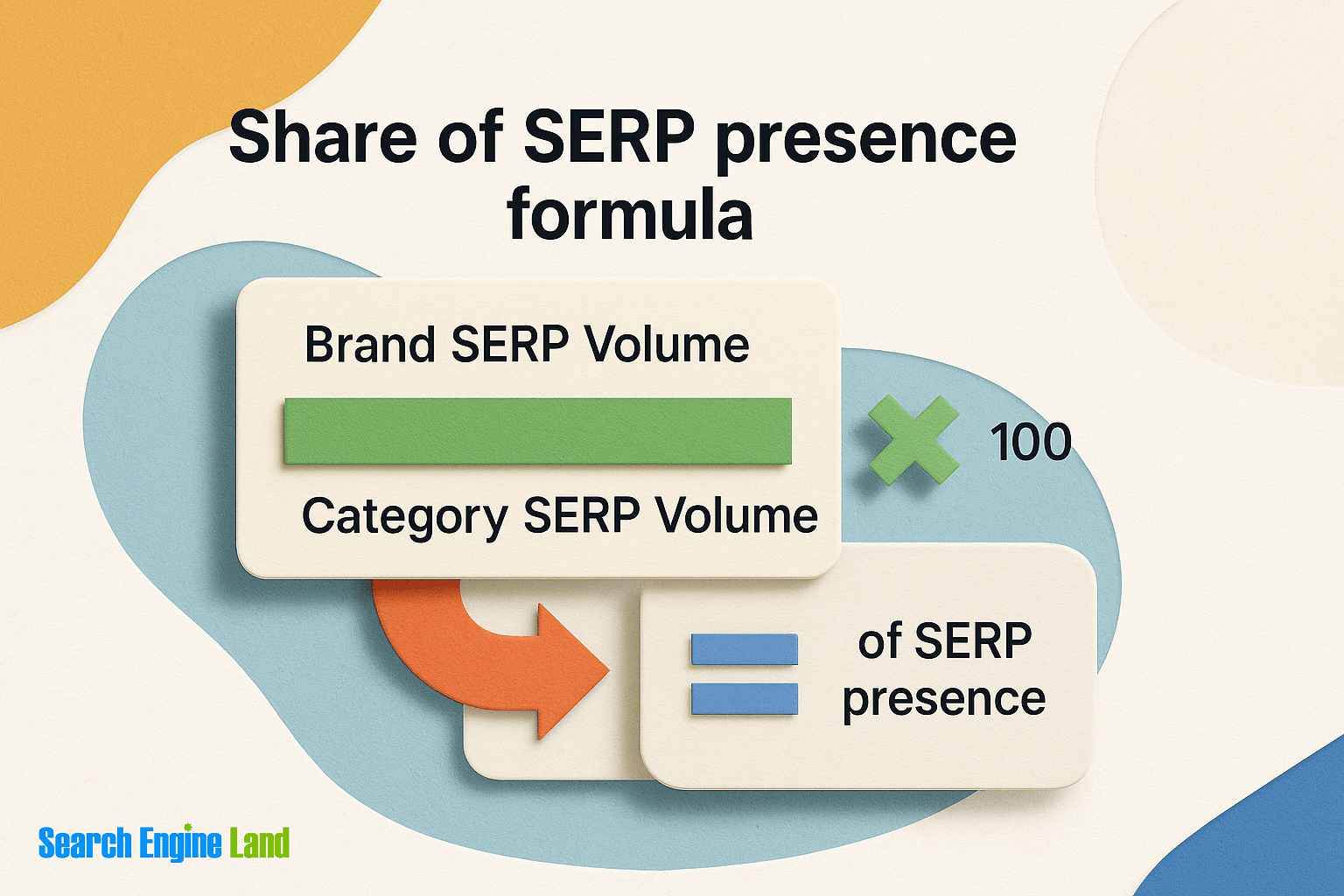
(Brand SERP Volume ÷ Category SERP Volume) × 100 = Share of SERP Presence (%)
The existing share of search metric assumes that each brand appears only once in the search results. But with the continued expansion of SERP features, each page of results now includes multiple spots for a brand to appear. Thus, if a particular keyword has five SERP features, then there are five times as many places for a brand to be mentioned in the results.
This means that to calculate SERP volumes, you need to multiply the search volume for each keyword by the number of SERP features that appear in the results for that keyword.
For example, say you’re tracking four keywords: “seo,” “ppc,” “geo,” and “aio.”
To calculate the category SERP volume:
- Multiply the total search volume of each keyword by the total number of SERP features available for that keyword to get the SERP volume for each keyword. (Don’t forget to include standard organic search listings as a SERP feature.)
- Total the keyword SERP volumes to get the category SERP volume.
| Keyword | Search volume | Total # of SERP features | Keyword SERP volume |
| seo | 301,000 | 10 | 3,010,000 |
| ppc | 60,500 | 9 | 544,500 |
| geo | 49,500 | 7 | 346,500 |
| aio | 27,100 | 7 | 189,700 |
| Total | 438,100 | n/a | Category SERP Volume = 4,090,700 |
For brand SERP volume, the calculation is the same. Simply replace the total number of SERP features with the number of features in which your brand appears.
| Keyword | Search volume | # of SERP features with brand mentions | Brand SERP volume |
| seo | 301,000 | 4 | 1,204,000 |
| ppc | 60,500 | 2 | 121,000 |
| geo | 49,500 | 1 | 49,500 |
| aio | 27,100 | 0 | 0 |
| Total | 438,100 | n/a | 1,374,500 |
To determine the share of SERP presence, apply the formula above using the totals:
(1,374,500 ÷ 4,090,700) × 100 = 33.6%
You can also make these calculations on a keyword-level basis to better understand where your search visibility opportunities lie.
| Keyword | Brand SERP volume | Category SERP volume | Share of SERP presence |
| seo | 1,204,000 | 3,010,000 | 40.0% |
| ppc | 121,000 | 544,500 | 22.2% |
| geo | 49,500 | 346,500 | 14.3% |
| aio | 0 | 189,700 | 0% |
| Total | 1,374,500 | 4,090,700 | 33.6% |
SEOs are already tracking search volume and calculating share of search. The added step of tracking the number of SERP features adds a little more complexity, but the idea should be familiar to anyone who has looked at these types of metrics before.
For a handful of keywords, it’s easy enough to keep an eye on the number of SERP features available. However, for a larger set, you’ll want to leverage tools to monitor the SERP landscape automatically on an ongoing basis.
Entity coverage
Associating your brand, products, and website with the right entities will benefit you more in zero-click search results than any other strategy. To make sure you have the right entity coverage, you need a metric that shows you which entities are tied to your brands—and which aren’t.
When it comes to modern forms of SEO—including generative engine optimization (GEO) and AI optimization (AIO)—entities reign supreme. That’s because Google and other AI engines use entities to understand queries and generate responses rather than simply matching keywords to content.
The first entities website owners think about are directly related to their business:
- Company name
- Website URL or title
- Brand(s)
- Product(s)
- Public-facing personnel
- Strategic partners and programs
Google recognizes searches related to many of these entities and displays Knowledge Panels that provide structured data results. The information in these Knowledge Panels is based on data in the Google Knowledge Graph.
What many SEOs don’t realize is that there is not a one-to-one relationship between a Knowledge Panel and a search result. In other words, different queries can bring up Knowledge Panels for the same entity.
For example, both “barnes and noble” and “bn” bring up a Knowledge Panel for the bookseller Barnes & Noble. This shows that Google closely associates both of these search terms with the same entity.
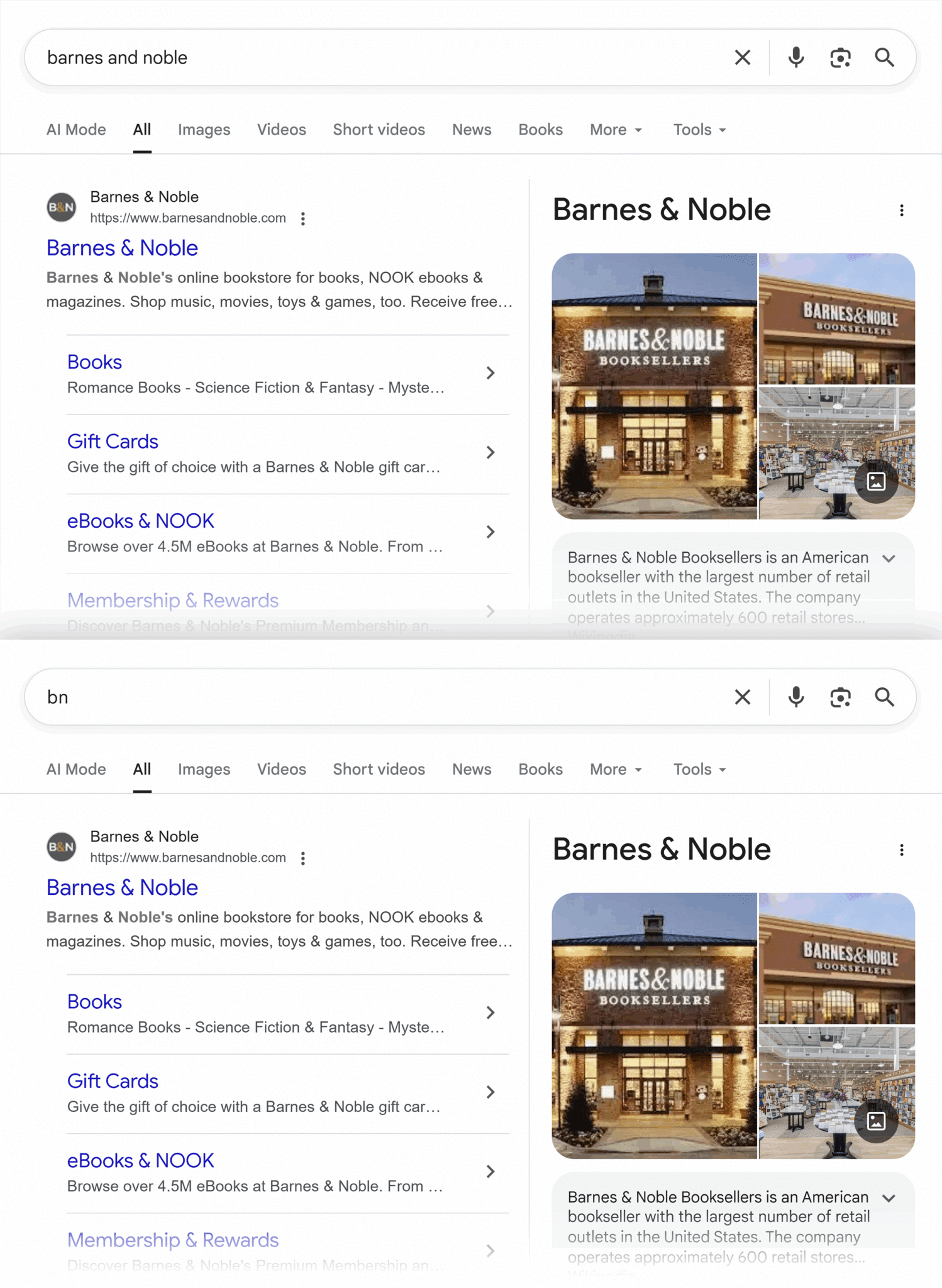
Importantly, the search results for the two queries are not the same. Although they are very similar at the top, “barnes and noble” results focus exclusively on the retail brand, while “bn” includes results for other brands and initialisms that use those letters.
Another way that Google associates brands with entities is by citing the brand’s website in the panel. For example, the search “sunrise on the reaping book” is associated with the book titled “Sunrise on the Reaping” by Suzanne Collins. The product page for this book on the Barnes & Noble website is also included in this Knowledge Panel.

By including this link, Google demonstrates a relationship between the Suzanne Collins novel and the product page on the Barnes & Noble website.
To distinguish between these two types of entities, let’s call them “primary” and “secondary” entities.
- Primary entities are the main subject of a search (e.g., “Barnes & Noble” in the searches “bn” and “barnes and noble”).
- Secondary entities are related entities that are linked in the Knowledge Panel of a primary entity (e.g., the link to the Barnes & Noble product page in the “Sunrise on the Reaping” Knowledge Panel).
To track entity coverage, you need to have an understanding of the keywords associated with both primary and secondary entities.
The primary entities to track will be the specific entities related to your business, such as those listed at the top of this section (company name, brands, products, etc.). You should make a list of all such primary entities, including common variations and abbreviations.
Note that these primary entities may not all have Knowledge Panels associated with them. Discovering which do and don’t is part of identifying gaps in entity coverage.
For example, Barnes & Noble owns the brands SparkNotes and Nook. When clicking on the links for each of these brands in the Barnes & Noble Knowledge Panel, it shows that SparkNotes also has its own Knowledge Panel—but Nook does not.

Pro tip: If you discover a search that you think should have a knowledge panel for a brand or product you own, or for yourself as an individual, you can attempt to trigger a knowledge panel.
As for secondary entities, you can discover which entities Google relates to your brand by noting which links show up in your entity Knowledge Panels.
The easiest (and fastest) way to do this is with Semrush’s Organic Research tool.
- Type in your website domain name and hit Enter.
- When the report is ready, click on the “Positions” tab.
- Select the “SERP Features” dropdown and choose “Domain ranks” > “Knowledge panel.”

When you scroll down to “Organic Search Positions,” you’ll see a list of all the keywords where a link in the Knowledge Panel goes to the domain you entered. (You can export the list by clicking “Export” at the top right corner of the table.)

This process focuses on Knowledge Panels because that’s the clearest way to see how Google maps keywords to specific entities. However, you can filter the Organic Research report to find links in other SERP features, as well.
The ultimate goal here is to arrive at a number that indicates entity coverage for your brand.
Entity coverage calculation
The total number of primary entities you track will likely remain relatively stable, though the keywords that represent those entities in search results may fluctuate.
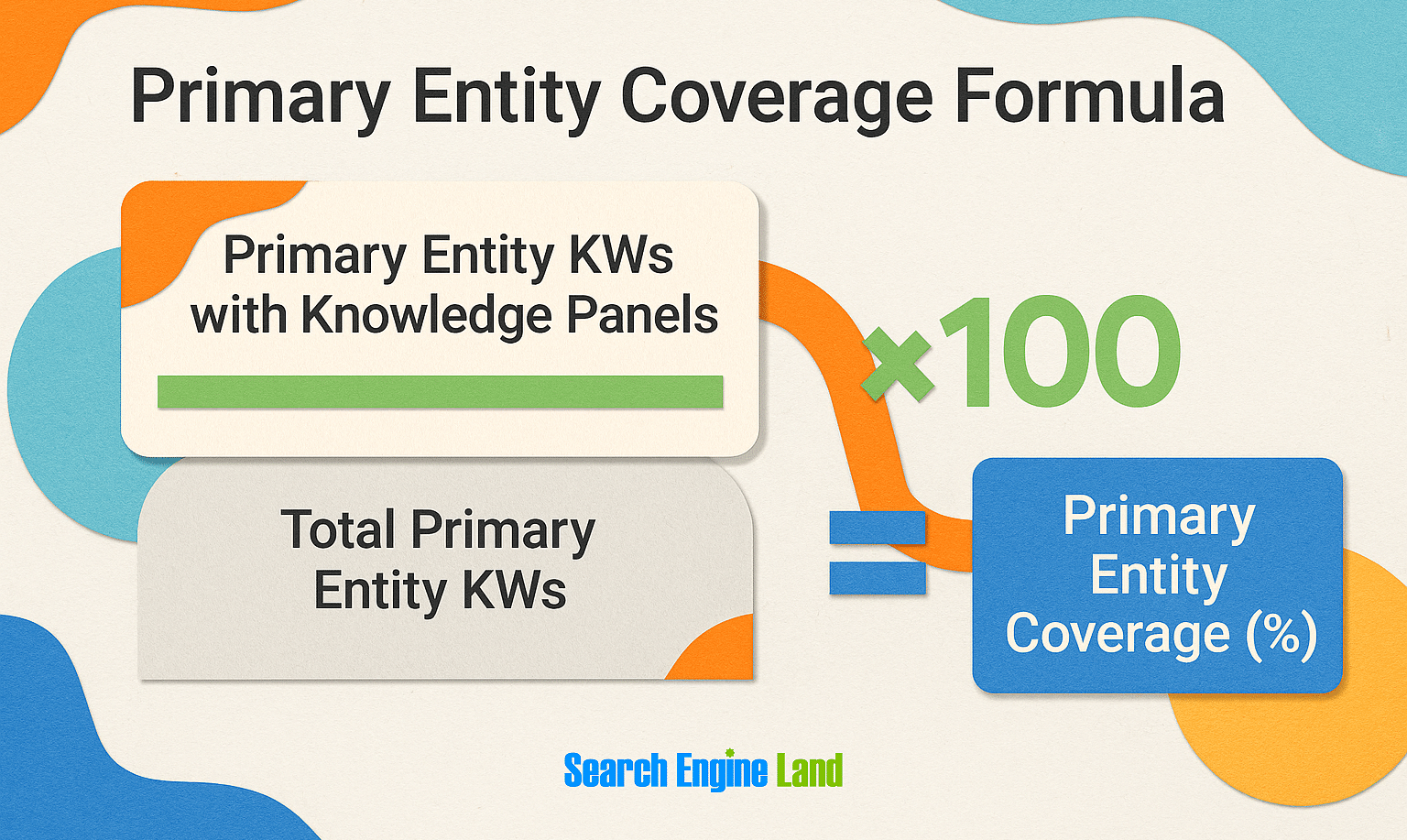
To get a stable metric, divide the number of primary entity keywords with Knowledge Panel presence by the total number of keywords tracked for your entities, and then multiply by 100 to convert to a percentage.
(Primary Entity KWs with Knowledge Panels ÷ Total Primary Entity KWs) × 100 = Primary Entity Coverage (%)
This percentage will let you compare snapshots over time to see if you’re increasing SERP coverage for your primary entities.
For secondary entities, calculating a percentage is not realistic, since the total number of secondary entity keywords that could trigger a Knowledge Panel may change dramatically over time.
However, tracking the total number of keywords and entities with citations for your website can be useful information to identify growth trends. Schedule regular updates (e.g., weekly) so you can monitor how things change over time and identify the impact of events like publishing new content or earning media coverage.
Brand mentions in AI results
It’s important to monitor your brand’s mentions in AI results. Doing so allows you to understand both how often your brand appears in response to queries and prompts and the context in which those mentions occur.
Google has two forms of AI-driven results:
- AI Overviews: These AI-generated summaries appear at the top of the SERP, within People Also Ask (PAA) answers, in Things to Know, and within other snippet-based SERP features.
- AI Mode: This full AI chat interface provides in-depth responses to conversational prompts, rather than traditional search queries.
While both types of AI results are driven by Google Gemini, there’s evidence that they treat brand visibility differently, with brand mentions tending to do better in AI Mode than in AI Overviews. The balance may continue to shift over time, but it’s likely that AI Mode will become the dominant way of presenting zero-click search results in the future.
Note: For the purposes of measuring brand mentions, other AI clients (ChatGPT, Claude, Copilot, Grok, etc.) work similarly to Google AI Mode. The biggest difference is the data they are trained on and the contexts in which they are used.
Tracking visibility across AI platforms is tricky. If you want to do it manually, here are some tips you can follow to manage the process:
- Create a standard set of prompts. Good results require consistent testing. Take time to thoroughly consider the prompts where you expect to see your brand, where you might not expect to see your brand, and where you definitely don’t want to see your brand. If you add to the prompt sets later, see if you can run tests on historical versions of the AI platforms you monitor.
- Identify relevant platforms. AI platforms spawn like hydra heads—for every one you’ve forgotten about, two more pop up the next day. Choose the ones you actually care about, and ignore those that don’t matter to your users, prospects, and business partners.
- Consider availability and usage. Monitor the AI platforms that are both available and being used in the areas, languages, and industries where you have a presence and wish to expand.
- Understand update cycles. Snapshots are important, but you’ll get more value by seeing how your brand visibility changes over time. Monitoring visibility after major updates of training data and other changes is important to determining what’s working and what isn’t.
- Analyze data both visually and qualitatively. Data visualization lets you spot patterns in how your brand is (or isn’t) being mentioned. Assigning quality scores and taking notes can also help you understand how the platform understands your brand’s relationships with other entities.
- Track competitors. You’re already doing the work of monitoring your brand and website, so you might as well see how you compare with the competition. Don’t just track the big names—emerging competitors may become visible in AI prompts before you’re even aware that they’re challenging your business.

In terms of what to measure:
- Brand mentions: The number of prompts mentioning the brand
- Citations: The number of prompts that include a link to a source about your brand (be sure to mark it as an owned, earned, or paid mention)
- Destinations: The type of content citations link to (e.g., product page, informational content, etc.)
- Prominence: Where the brand is mentioned within the response (e.g., at the very top vs. the end of a “top ten” list)
- Sentiment: Positive, negative, or neutral (i.e., cited for factual information only)
- Share of voice (SOV): The percentage of overall brand visibility within your prompt set compared to competitors
- Visibility over time: The increase or decrease of mentions as time goes by
As with the other visibility-first metrics discussed above, you can track these on your own. Or you can get help tracking them with the advanced tracking methods discussed in the next section.
Track, optimize, and win in Google and AI search from one platform.
Further reading: How to monitor brand visibility across AI search channels
Advanced tracking metrics
As AI platforms mature and their functionality becomes more complex, measuring success inevitably becomes more difficult. New tracking tools and methods will need to be deployed to cover the breadth and complexity of these platforms.
Some of these tools are already available:
- AI visibility indexes
- Impression share data
- Entity-based analytics
AI visibility indexes are broad-scope tools that collect massive amounts of data from the range of popular AI tools. Similar to search indexing tools, these tools give users aggregate insights about brand visibility in generative AI platforms, while also providing an opportunity to dig into specific topics, prompts, and platforms.
One such index is the AI Visibility Index, which integrates its long history of traditional search data with newer AI prompt visibility data from Google’s AI Overviews and AI Mode, as well as platforms like ChatGPT.

Indexes are great for reporting on the high-level state of things and digging into industry-level data. For individual brands, tools like the AI SEO toolkit let you dig into specific metrics for that brand. (See “Zero-click measurement tools and reporting frameworks” below for details.)
Impression share data in Google Search Console has long been a staple metric for tracking brand visibility in search results. As Google began directly answering more search queries in AI Overviews and AI Mode, it started including impressions and traffic for cited links from those SERP features in Search Console, as well.
There are a few caveats, however:
- For impressions to count, AI Overviews must be expanded to show the link citation.
- All the citation links in an AI Overview are assigned the same position.
- Search Console does not distinguish between impressions in AI Overviews or standard search result listings—they’re all included in the count for “Web” impressions.
Google may provide more granular impression data in the future. In the meantime, tools like Position Tracking can help you keep an eye on the visibility of your brand in AI Overviews, along with other SERP features.
Once you set up your Position Tracking campaign, you’ll have access to a number of different reports related to the keywords you track. Included in them will be a “SERP Features” report that shows the number of keywords where you maintain a presence in AI Overviews and other SERP features.
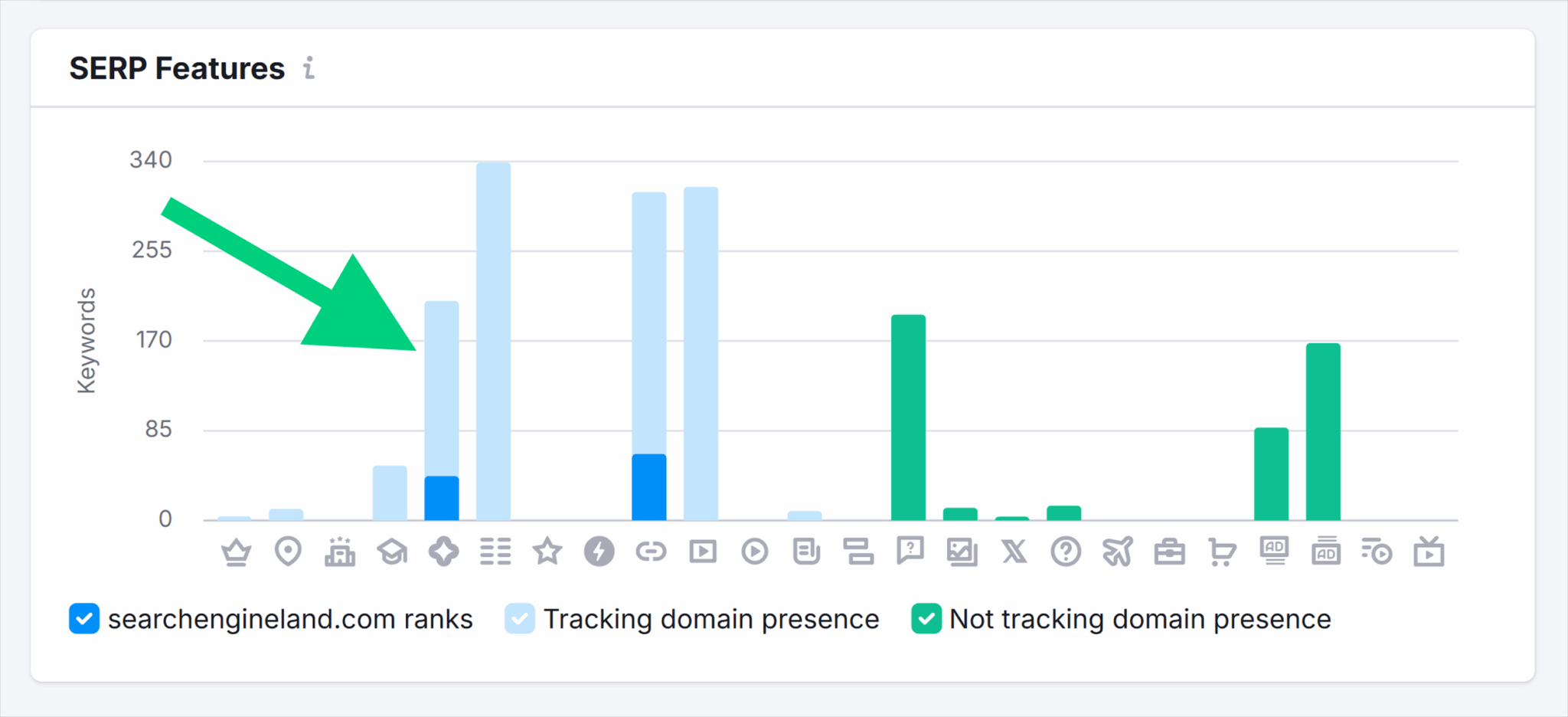
Additional ways to track impressions across Google’s AI Overviews and other AI-driven results will continue to improve over time.
Entity-based analytics and entity tracking are other ways to monitor your brand visibility. In some respects, entity analytics is the other side of the coin with respect to visibility search metrics.
Unfortunately, a lot of SEO tools haven’t yet caught up and started focusing on entity-based analytics. Rather, they still focus heavily on specific keywords and prompts to drive their reports and insights.
Nonetheless, there are some things you can do to start thinking about an entity-based approach to tracking brand visibility in AI-driven results:
- Identify queries that map to the same entities. For example, SERPs for “apple” and “apple inc” both include results for the same entity, even though the specific results have a different emphasis (retail and products versus corporate information for investors, job seekers, etc.).
- Find branded queries where your brand should be considered the primary entity. These represent opportunities to perform entity-based SEO to strengthen Google’s understanding of the relationship between your brand and the search terms.
- Use traditional SEO analytics to identify entity candidates. When looking at data from Search Console, Google Analytics 4 (GA4), and other SEO tools, analyze it from an entity mindset rather than a keyword mindset. Use projects, tagging, and annotations to organize related terms into entity-based structures.
SERP features are the new battleground
Modern SEO is about more than making sure your website sits in the top spot. It’s about making sure your website sits in the right spots.

The high-visibility SERP features most relevant to no-click search results are:
- Featured snippets: Also called “answer boxes,” “position zero,” and a host of other things, these are excerpts of webpage text that prominently appear at the top of SERPs or within other features like PAA and Things to Know.
- AI Overviews: In contrast to featured snippets, these are AI-generated text answers based on content from multiple web pages. They can also appear at the top of search results and within other SERP features.
- Knowledge Panels: These consist of quick-hit factual information related to the primary entity of the search. The data is pulled from Google’s Knowledge Graph.
- People Also Ask (PAA): This feature lets users explore questions and answers similar to or related to the original search.
These features are important because they provide additional places for brand mentions (and links) to appear besides a search result listing. Some of these features offer multiple opportunities for brands to appear.
Let’s do a little case study to see how this works in a real SERP.
When it comes to ebook readers, the Amazon Kindle has long dominated the ebook market. Surprisingly, however, the SERPs for “ebook reader” heavily favor a competitor—not the Barnes & Noble Nook, as might be expected, but rather the Rakuten Kobo.
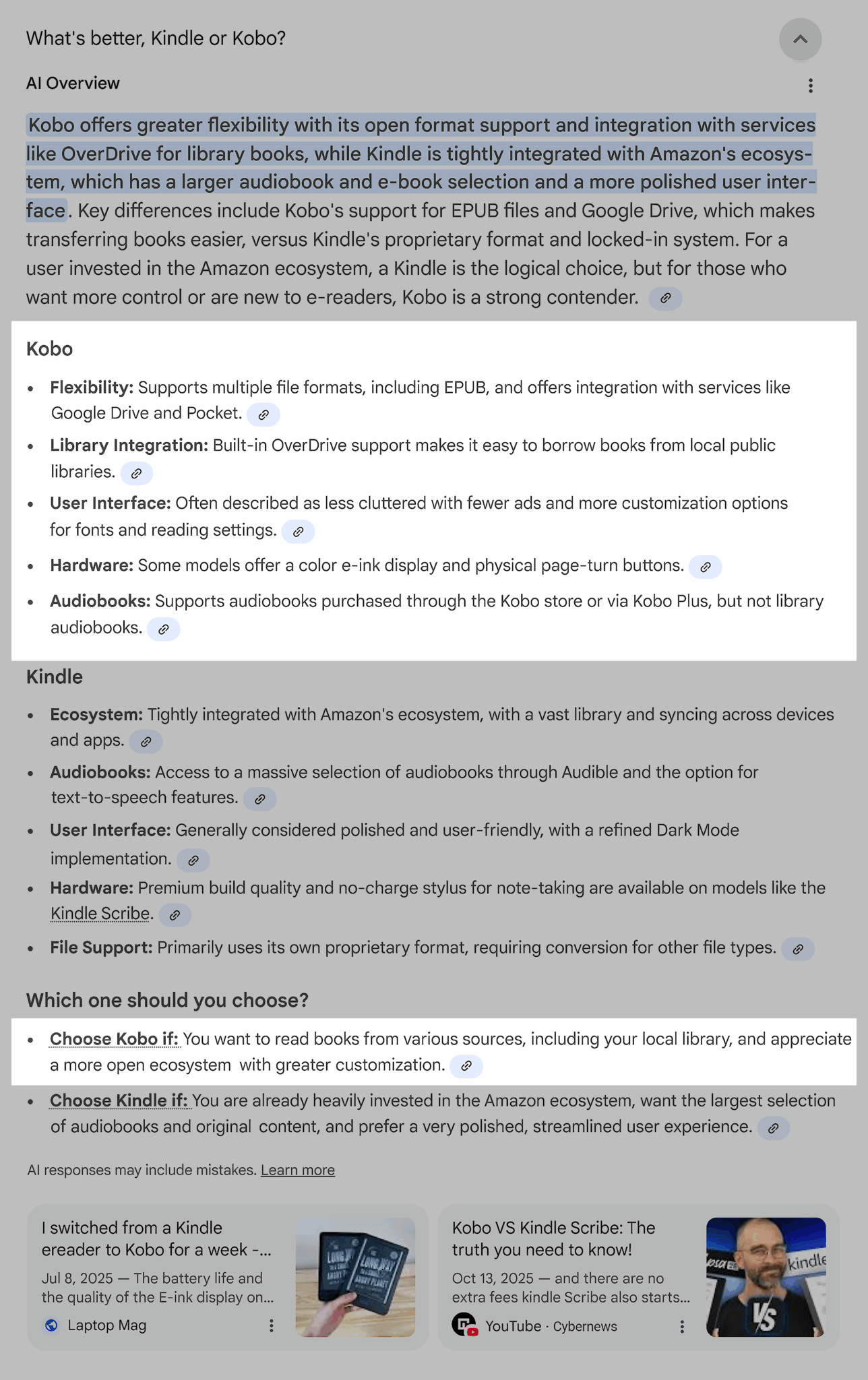
In addition to ranking in the top spot (Amazon’s “Ebook Readers” page comes in at number five), Kobo makes a prominent PAA appearance in the question, “What’s better, Kindle or Kobo?”
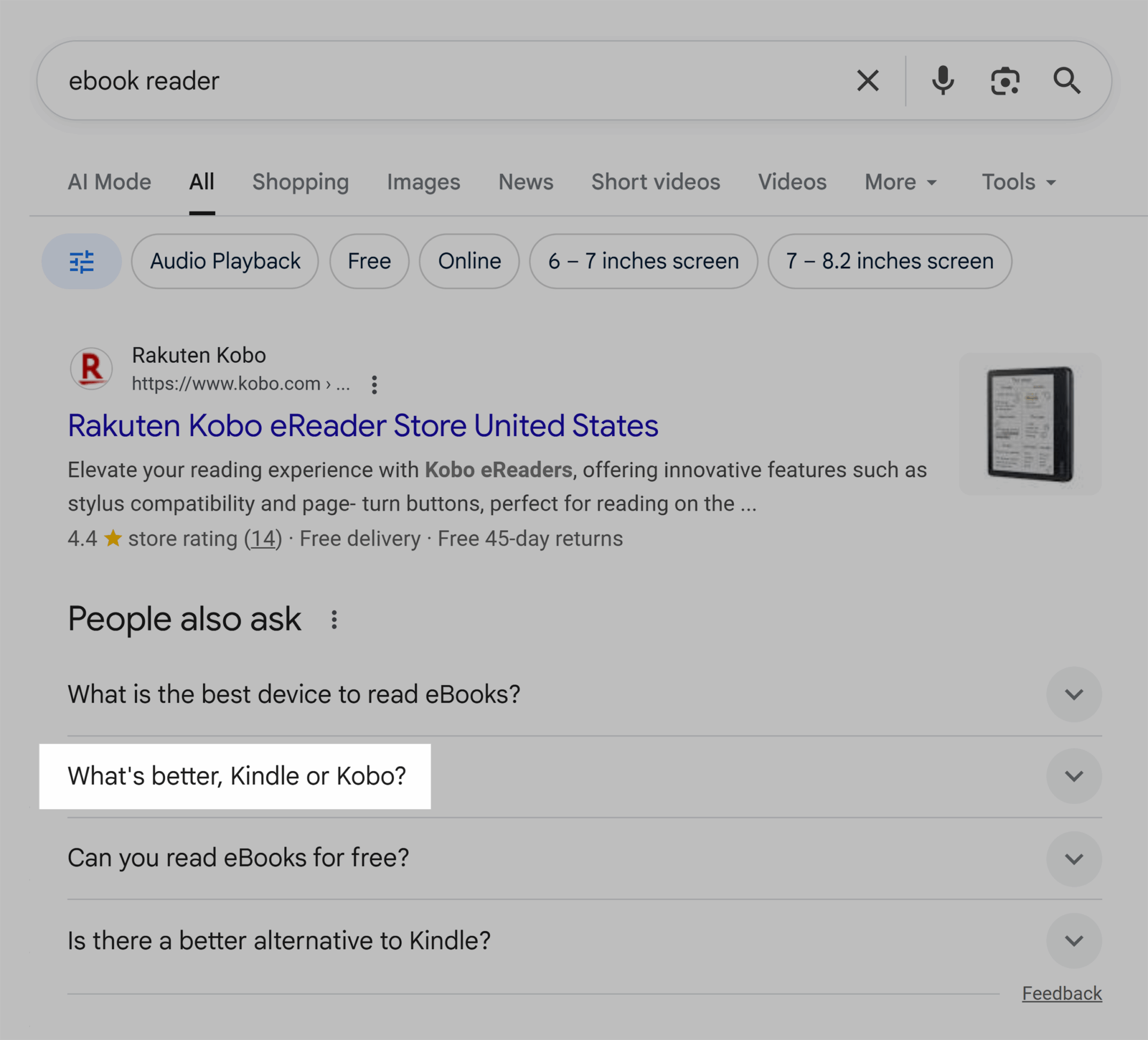
The answer to this question provides an AI Overview comparison of the two products. Although the answer emphasizes that the preference for one product over the other is subjective, it places the Kobo’s benefits and features above the Kindle’s.
Opening the answer to another PAA question shows a featured snippet from a review listing a Kobo product as the best color ereader, sandwiched between two Kindle options.

Given that this high-difficulty search has a mix of product and comparison results, it’s clear that Rakuten has invested a lot of time and effort in associating its Kobo products with the entity “ebook reader” in an attempt to challenge the Kindle’s market dominance.
A consumer looking to buy a new ebook reader might realistically have come to these SERPs intent on buying a Kindle, but purchasing a Kobo instead.
As this example shows, zero-click search doesn’t mean zero value. Brand visibility across a variety of SERP features allows users more opportunities to act upon the information in those features.
Prioritize influence over clicks
Zero-click results are forcing SEOs to look at organic search marketing in a new light. Clicks haven’t gone away, but the landscape is quickly shifting from a click-based environment to an impression-based one.
This is an exciting development, as it offers more opportunities to highlight your brand’s products and key personnel in ways that didn’t exist before. The ability to appear multiple times in SERP features like AI Overviews, PAA questions, and related searches has greater potential for visibility than appearing in a single search listing far down in the SERPs.
At the same time, C-suite leaders and executives have been trained to look at click metrics and their relationship to business revenue. It may be hard to convince them that a world with fewer clicks can be positive.
Here are some things you can tell leaders to contextualize the new zero-click search landscape.
First, Google will continue adding features that fragment the SERPs and serve multiple search intents for the same search query. That’s because Google wants its users to stay on Google. This means that having a strong, visible presence in AI-driven search features puts you in the place where the users are, and it keeps your brand at the forefront of their minds when it comes time to make a purchase.
Second, the user journey has never been a straight path from search results click to call to action (CTA) to transaction. Whereas consumers may have hopped in and out of sites to look at product descriptions, reviews, comparisons, and related content, now they can get most of that without needing to leave the search results. Persistent visibility in relevant results lets those consumers see that a brand offers a viable and valuable solution to the problem they’re trying to solve.
Third, zero-click organic results can be paired with strong paid ad and product listings in heavily transactional searches. If an AI Overview or PAA answer lists your product as one of the best in the industry and there’s an opportunity to buy right there, then you can still drive conversions even without the clicks.
Finally, the rise of zero-click search also offers a great opportunity for you to reconsider how your brand shows up beyond the traditional search results. For example:
- Non-browser searches: AI-generated results drive things like voice search, Google Discovery, and Google Lens, in addition to the traditional browser-based searches. An influence-based approach focused on entity coverage will benefit these types of non-browser searches.
- Attribution model: Understanding the nature of the customer journey as a non-linear process is critical in the ever-more-integrated world. Zero-click searches are one more reason to adopt a new marketing attribution model that accounts for the many ways consumers actually decide what to buy.
- Refocused value: Instead of focusing on specific metrics that can be gamed (e.g., publishing content for clicks that don’t convert), you can redirect your efforts to measuring the true impact of your brand messaging by seeing how they show up across the search landscape.
At the end of the day, if you approach zero-click search with a visibility-first mindset, you’ll find that there’s likely more opportunity than ever to capture users’ attention. And that’s what good brand messaging should always do.
Zero-click measurement tools and reporting frameworks
The continued rapid expansion and prevalence of zero-click SERPs has led SEO tools to build new ways to monitor and measure search visibility across SERP features and entities.
The AI Visibility Index is one such tool that provides broad insights beyond traditional search metrics.
For example, one key insight is how much information sources differ between different AI platforms:
- Google AI Mode prefers LinkedIn, Yelp, and its own products.
- ChatGPT relies heavily on Wikipedia, Reddit, and industry sources like TechRadar, Forbes, and Clutch.co.

Indexes like this are great for understanding the generative AI landscape as a whole. For example, if your brand is already showing up well in Google, but you want to improve visibility within ChatGPT, you can focus on getting mentions and citations where the platform sources its data.
To dive into metrics for an individual brand, you can use the Semrush AI SEO toolkit. The toolkit has a lot of great features for monitoring topics and suggesting improvements for greater visibility across AI platforms like Google’s AI Mode and AI Overviews, as well as ChatGPT and others.
The Brand Performance area is incredibly useful for seeing how your brand stacks up to competitors in both sentiment and share of voice.

In the “Narrative Drivers” section, you can dig into brand mentions and citations in AI-generated answers for both branded and non-branded questions.
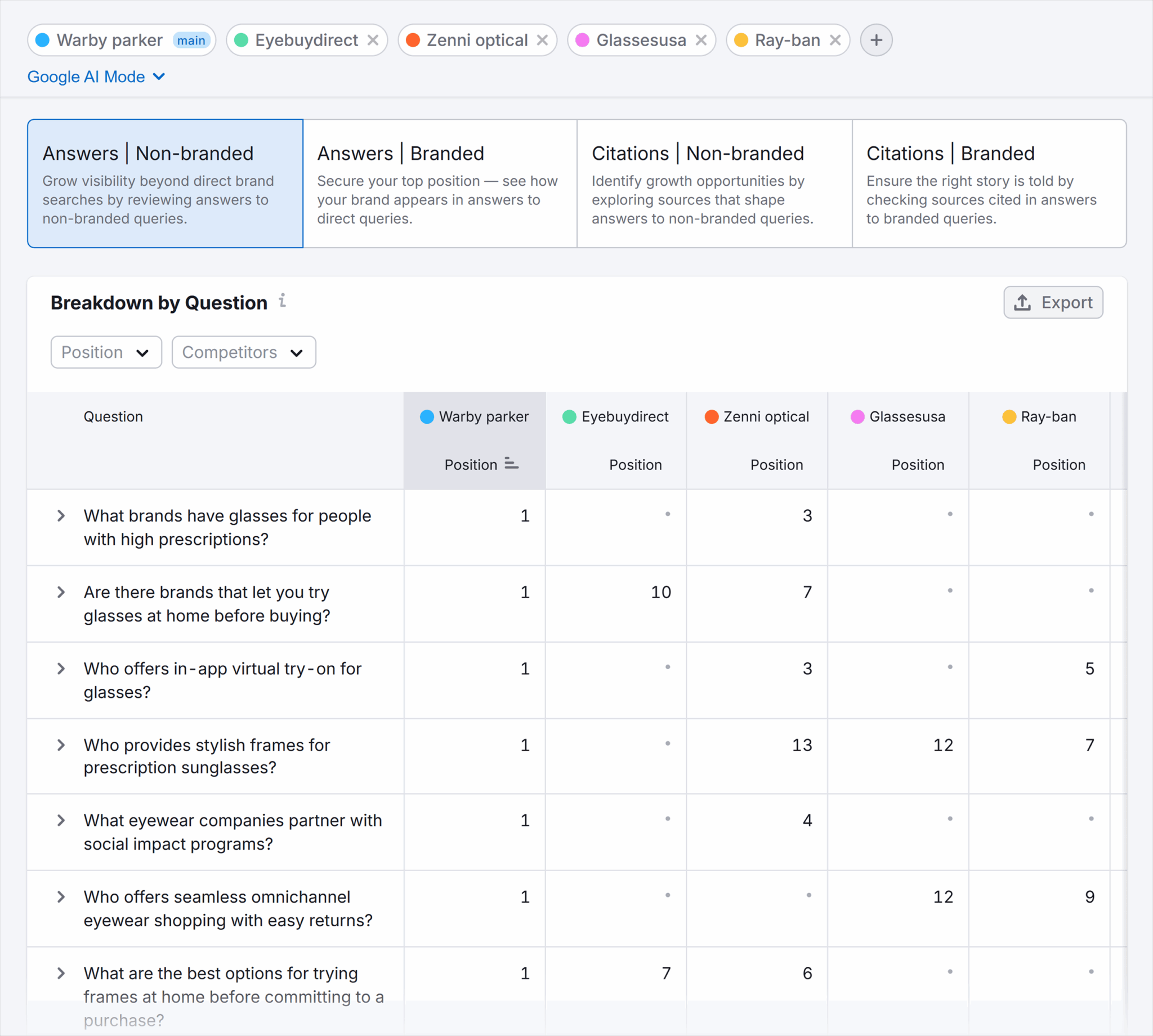
There are a lot of other reports that can give you good insights into where you’re winning in the no-click AI search landscape—and where you can improve visibility.
Here are some of the other things you can find:
- Brand Performance: Insights on share of voice (SOV), sentiment, key business drivers, competitors, and opportunities
- Perception: Detailed analysis of general sentiment, as well as competitor comparisons
- Narrative Drivers: SOV breakdowns and prompt-level analysis
- Questions: Aggregate topic and prompt insights with strategic opportunities
Pro tip: For a full breakdown of how to track brand visibility and optimize for large language models (LLMs), see our guide on what the AI Visibility Index tells us about LLMs and search.
In addition to these tools, you can still use Google Search Console data to track positions, impressions, and yes, even clicks.
Google does not distinguish between traditional search listings and SERP features in these metrics. However, AI Overviews and AI Mode are included in the data, which gives you a good sense of your overall brand visibility across SERPs.

Combined with the mention and citation data from the AI SEO toolkit, as well as the metrics discussed above, these tools will give you a good start in building out a dashboard that reflects the true value of visibility-first SEO.
Zero-click expands SEO’s role—it doesn’t end it
AI SEO is the path forward. It’s the only logical response to the reality of zero-click search, and embracing it sooner rather than later will put you in a better position than your competitors.
Rather than optimizing for rankings, it’s time to optimize for recognition, trust, and presence in every place internet users go for answers.
Now that you know how to measure success, start building your AI search strategy.
Explore more on
Editorial disclosure
Search Engine Land is owned by Semrush. We remain committed to providing high-quality coverage of marketing topics. Unless otherwise noted, this page’s content was written by either an employee or a paid contractor of Semrush Inc.
About the author